To Exist In A State Of Frequent Despair
When I was around 5-years-old, I started praying to “God”. I don’t know why. I had never been to any kind of church, and as far as I knew at the time, no one in my family was religious. I don’t recall ever asking anyone how to or why you would pray to “God” because I didn’t expect I would get an answer. Not from a lack of knowledge on their part. My grandparents both grew up religious - my grandpa is Italian-Mexican American (Extra Super Catholic), and my granny had been in schools with nuns as teachers (she dislikes nuns to this day). My mom and her brother both had been baptized, did first communion, and confirmation. At some point, and to some degree, all the adults I knew at 5-years-old were religious.
I wasn’t baptized. No one talked about religion with me, not even the best friend I had that lived next door to my grandparents, and her family was “the go to church all the time” kind of religious. I did go to some kind of church thing with her in later years, and I found it confusing and stuffy, but that’s a tangent.
So, I’m five-years-old. I don’t know why I got the idea to pray to “God” or why I thought you had to close your eyes to do it, or why I started with the word “dear” like I was writing a formal letter for school, but I felt like my problem was bigger than me and I needed help from someone with more pull than I had.
I was sitting in the backseat of the family car. We were going towards our home, maybe 2-3 streets from it. I closed my eyes as tight as I could, so tight that a kaleidoscope of colors started unfurling on the inside of my eyelids to the pulse of my heartbeat. I folded my hands together in my lap.
Dear God, please help me wake up from this nightmare. I know this isn’t my real life and I’m not supposed to be here, but I can’t wake myself up. I just need some help. Thank you.
I repeated some variation of this multiple times a day and night until I was about 10-years-old. At that age, I decided that what I was doing was useless because there clearly wasn’t a “God” and I was just talking to myself. I started self-injuring and having full-blown suicidal ideation. The only way out, for me, was to die.
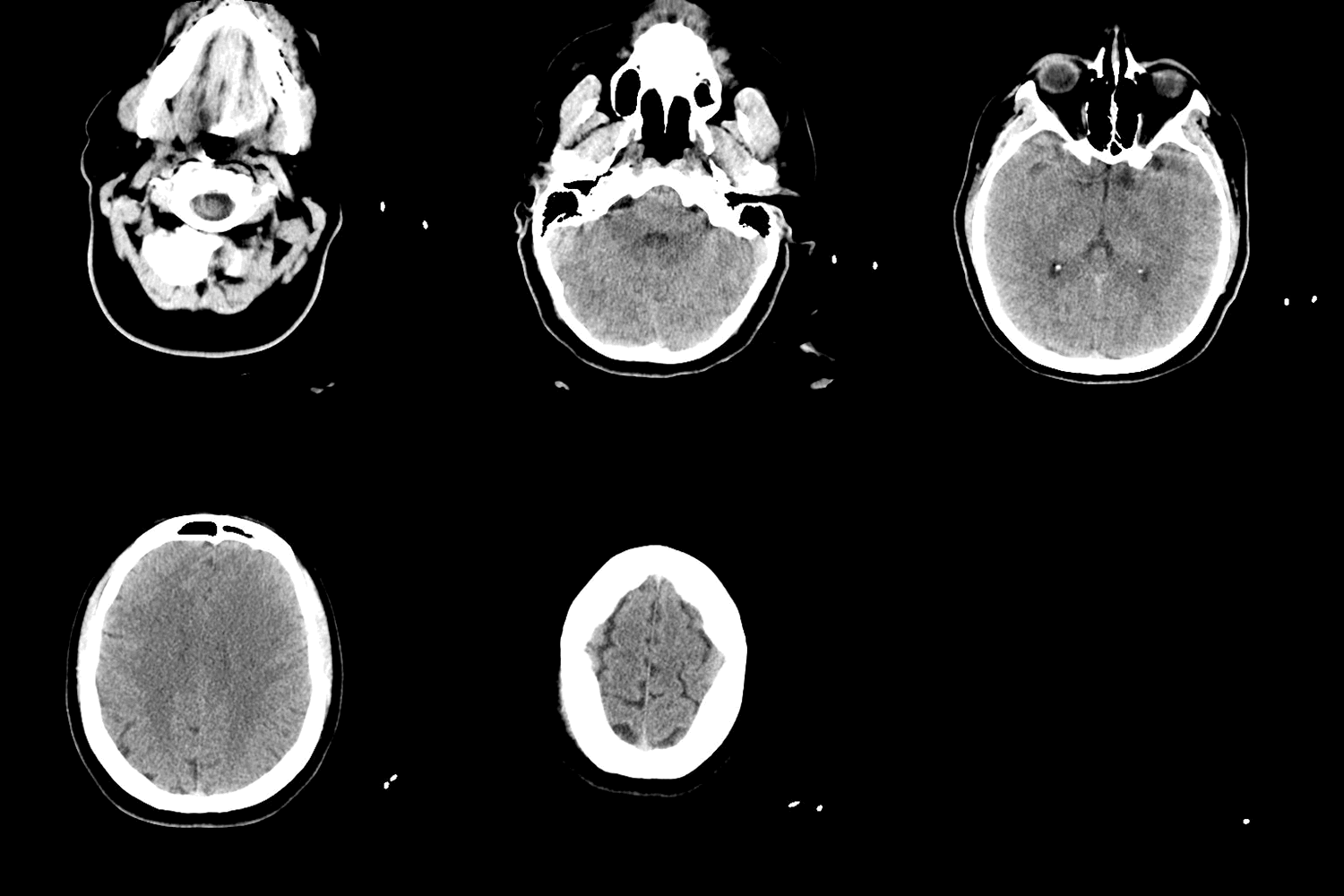
Cotard’s syndrome is often referred to as “walking corpse syndrome” or “deadman’s syndrome” in media. The man it is named after, Jules Cotard, a French neurologist in the 19th century, called it le délire des négations or “the delirium of negation”. It’s a condition where the person experiencing the delusions believes they are dead. There are a variety of other delusions that sufferers of Cotard’s syndrome present with, but they all firmly believe they are dead or actively dying.
The earliest recorded case of Cotard’s syndrome was in 1788 (about 100 years before Jules Cotard), and was reported by a guy named Charles Bonnet. A woman, always described as “elderly” but with no age ever given, was getting a meal together when she suddenly had what we would say today was a stroke. After this incident, she was convinced that she died. I was not able to find out how long between the possible stroke and the onset of the delusions was. This is the unfortunate issue when researching on the internet - every instance of someone writing about Cotard’s has the exact same paragraph about this unnamed woman’s trauma, no changes, no extra details, no original source.
Anyhow, she’s 100% convinced she’s a corpse. She’s very insistent on this fact, so much so that she eventually wears her daughters down into treating her like a corpse. They wrapped her in a shroud and displayed her for people to view and mourn her. Sometime during this mock wake, she fell asleep, and her daughters de-shrouded her and put her to bed. After this, they attempted to treat her as best the could in the 18th century, and, as all the paragraphs end, she never fully recovered from her delusions.

Jeanne d'Arc by Albert Lynch
I started self injuring by scratching my scalp until the skin would break, bleed, and scab over. I then added burning myself. Again, in a weird religious connection, I had watched a show about a girl who became obsessed with Joan of Arc and would burn herself. I didn’t keep the burning habit for very long.
The methods of self injury that stuck with me the longest were cutting myself, binge/purge, and starving myself. No one bothered trying to stop me because no one bothered to notice. Nothing I ever did was worth noticing and my health was never important enough for someone else to intervene. That was, and still is, how things were for me growing up. When my parents finally did find out I was cutting myself, I was told to “fix yourself”.
Needless to say, I was not able to fix myself then. I did try to do the work of going to talk therapy, then medication, then both, and then none. Anyone with mental health issues knows that finding and getting help is not easy. I was put on every drug my doctors had samples of from pharma reps or had ever been linked with treating depression or bipolar disorder. They all slowed me down, made me gain weight, and helped wreck my liver (the alcohol also helped with that), but nothing ever made me feel “better”. Not that I knew what “better” was supposed to feel like. I still don’t know.
Talk therapy was pretty much the same. First, it was difficult to find anything affordable or covered by insurance (when I had it). After that hurdle, it was going to one, maybe for a number of appointments, not getting anywhere with it, starting over. I’ve had ones that tried to mother me, put me on meds that I told them made me feel off and ignored me until I tried to kill myself, and ones that just didn’t give a shit and were wasting 45-mins for the copay. I eventually stopped taking medications and seeing therapists for about 10 years.
Which, surprise, didn’t really help with anything. By 2013, I was having a BAD time. My CPTSD/PTSD was just running rampant. I didn’t sleep, I had agoraphobia, I was going to work and right back home to my bedroom. I don’t remember why, but I decided I should try therapy one more time to try and at least get some functionality back, or get some sleep. I got scheduled with a therapist whose office was right next to the office of the one who put me on the medication that didn’t sit well with me, and I started EMDR therapy with them. To my pleasant surprise, it worked.

EMDR therapy is Eye Movement Desensitization and Reprocessing therapy. It involves the patient moving their eyes a specific way while they process the memories of a traumatic event. After a number of sessions, I was feeling better than I had all of my twenties. My therapist, on the other hand, decided I was going to be their project and started diagnosing me with other disorders that had not come up once in any of my prior attempts with therapy.
I was in my car wreck before they could really work on the new diagnosis. I later discovered they put in my medical record that I “refused treatment”. I was in hospital and couldn’t walk. I had emailed them between surgeries so they would know I hadn’t just ditched out on therapy. Also, this was all with Kaiser Permanente, whose commercials would lead me to believe that all your doctors there have access to your medical files. Healthcare shouldn’t feel like playing a questionable gambling app on your phone.
The patient that Jules Cotard based his description of the condition that would later share his name on is only known as Madamoiselle X . She is said to have complained to doctors that she “had no brain, no nerves, no chest, no stomach, and no intestines”. She refused to eat, because what was the point of eating if you were already dead? Cotard’s description of Madamoiselle X’s condition became the foundational text on the disorder, but the research I did wasn’t clear at all if X was actually his patient, what they tried to do to help her overcome her delusions (if they tried anything at all), or what led up to her delusions. It is said she eventually died of starvation. Actually dying due to the delusions of Cotard’s seems to be rare, in modern cases of it, at least.
The syndrome isn’t classified as a disorder on its own in the American Psychiatric Association’s Diagnostic and Statistics Manual of Mental Disorders, or the DSM-5. While this text has some very valid criticisms about its usefulness as a diagnostic tool (not to mention its history of labeling things as mental illnesses that just aren’t), it is still used widely today. This might be why most of the time, Cotard’s patients are diagnosed with something that is listed in the DSM-5 and the known number of people suffering from the delusions are so small.
According to Dr. Jesús Ramírez-Bermúdez, head of the neuropsychiatry unit at the National Institute of Neurology and Neurosurgery in Mexico City, Mexico, he would see patients diagnosed with schizophrenia when they started presenting symptoms of Cotard’s. Which makes sense when using the DSM-5 to diagnose someone. Having delusions is associated with a wide range of neurological conditions, schizophrenia being just one, and the nature of the delusions are just as diverse as the conditions that cause them.
If a doctor is given a patient that is convinced they are dead and have a twin that is still alive (an actual patient Dr. Ramírez-Bermúdez treated), the doctor will use the tools and training they’ve had and see if the patient has any symptoms of dementia, Parkinson’s disease, brain injury, schizophrenia, bipolar, or any of the other conditions known to cause delusions and depression (because depression is the MAJOR factor with Cotard’s). What will most likely not happen is that the doctor will immediately go to a little known disorder that is specifically described as having the delusion one is no longer alive.

When I woke up in the ICU on the 27th of July, 2014, I had no idea where I was. I had no idea what happened, what day/month/year it was. I had no memory of anything that had happened to me recently. It felt like I was waking up from a dream and couldn’t really remember anything about it other than I had been dreaming. It’s a very vague feeling, like watching the GIF of the raccoon trying to “wash” handfuls of cotton candy. I still can’t remember anything that happened leading up to the car wreck, the wreck itself, or those two days after the wreck. Even my time in hospital after leaving the ICU is fuzzy now.
What I do remember about being in hospital is that morphine is great. I have never felt so agreeable in my whole entire life. Sure. it sucked that I couldn’t feel my mouth and eating was just not worth it. Everything hurt and I couldn’t walk. I was pretty sure the doctor that put my ankles back together hadn’t ever watched a movie for entertainment purposes. I could not keep track of time. No one could (or would, I still haven’t decided which) tell me what happened other than I was in a rollover car wreck. Still, morphine made all that seem like nothing to worry about.
When I got out of hospital, it took until the oxy script had run out and my undiagnosed traumatic brain injury (TBI) starting to really present itself for shit to hit me hard. Shortly after, this odd feeling started to creep into my head. I can’t pinpoint exactly when it first popped up, but it would hit with a clarity that none of the rest of my thoughts were hitting since the wreck. Most of the time, it’s like my brain is shuffling through files that have been scattered all over a room. This one would just pop up and hang there so I could focus on it.
I died in that car wreck. I died and this is Hell.
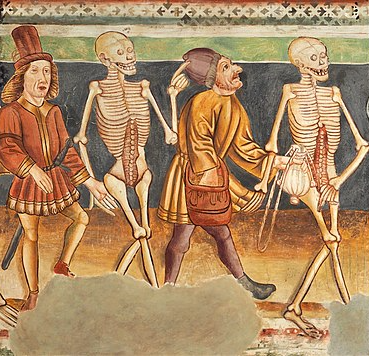
Section from Dance of Death (replica of the 15th century fresco), National Gallery of Slovenia
REFERENCES
Consoli A;Soultanian C;Tanguy ML;Laurent C;Perisse D;Luque R;Berrios GE;Cohen D; (n.d.). Cotard's syndrome in adolescents and young adults is associated with an increased risk of bipolar disorder. Bipolar disorders. Retrieved January 25, 2023, from https://pubmed.ncbi.nlm.nih.gov/17845283/
Cotard's syndrome: The disorder that makes you think you're dead. Anthropological Perspectives on Death. (n.d.). Retrieved January 25, 2023, from https://scholarblogs.emory.edu/gravematters/2017/03/24/cotards-syndrome-the-disorder-that-makes-you-think-youre-dead/
Hayasaki, E. (2015, September 22). Living with being dead. Medium. Retrieved January 25, 2023, from https://medium.com/matter/living-with-being-dead-844b4b1e668
Kim, M. (2015, November 2). This rare illness makes people think they're dead. The Washington Post. Retrieved January 25, 2023, from https://www.washingtonpost.com/national/health-science/zombie-disease-makes-people-think-they-have-died/2015/10/30/ca8ab52c-532f-11e5-933e-7d06c647a395_story.html
National Institutes of Health. (n.d.). National Library of Medicine - National Institutes of Health. U.S. National Library of Medicine. Retrieved January 25, 2023, from https://www.nlm.nih.gov/
Pugle, M. (2022, June 9). Cotard delusion and bipolar disorder: What's the link? Psych Central. Retrieved January 25, 2023, from https://psychcentral.com/bipolar/cotard-delusion-bipolar
Soniak, M. (2013, June 2). 10 case reports of Cotard's delusion. Mental Floss. Retrieved January 25, 2023, from https://www.mentalfloss.com/article/50197/plight-living-dead-10-case-reports-cotard%E2%80%99s-syndrome
Wikimedia Foundation. (2023, January 21). Diagnostic and statistical manual of mental disorders. Wikipedia. Retrieved January 25, 2023, from https://en.wikipedia.org/wiki/Diagnostic_and_Statistical_Manual_of_Mental_Disorders